
Episode Transcript
Read the full transcript below:

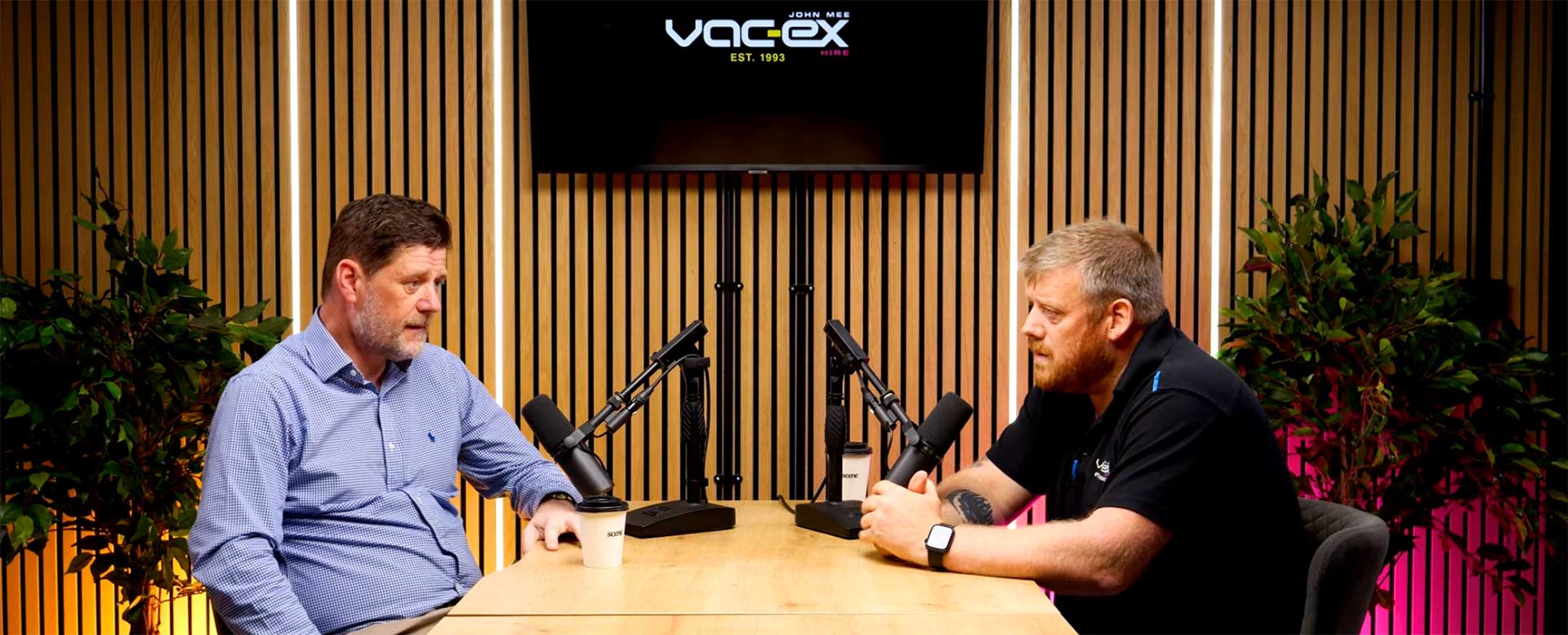
What is it really like working as a vacuum excavation operator – and why do so few people know this career exists?
In the first episode of The Vac-Ex Podcast, we take an honest look at careers in vacuum excavation, how people find their way into the industry and the opportunities available in a specialist sector that many people have never considered.
 Hosted by
The Vac-Ex Team
Hosted by
The Vac-Ex Team
 Guests
Dave Branney - Operations Director
Guests
Dave Branney - Operations Director Duration
47:47
Duration
47:47
 Watch on YouTube
View on YouTube
Watch on YouTube
View on YouTube
Read the full transcript below:
Some people think the industry’s got a recruiting problem, the vacuum excavator industry.
I don’t think there’s a clear pathway either from college.
I genuinely could not give you a standard brief on what I would like to see coming through the door as a new trainee Vac-Ex operator. It’s surprising how many of them say, “This is actually quite difficult.” It’s a technical role.
Yeah. I don’t think there’s anything more exciting than driving a 32-ton truck across country with a full tip and then taking out a powered arm and sucking the ground away. You know what I mean? I think it’s quite exciting.
I don’t know about you, Pete, but I did not have a clue what vacuum excavation was before I came into this business. I just didn’t know they did it. I thought, you know, you excavate with a digger and a shovel and a spade. I didn’t know that option was out there. So, had you heard of it before?
No, not really. Like I said, you think it’s some sort of sewage sucker, don’t you?
Yeah.
But then the more and more you look into it, you actually think, well, actually, yeah. You can understand why they do it.
A lot of sites are mandating that you have to have it now, aren’t they? Some of the tier ones are saying that, especially in gas and water and where it’s high risk.
Yeah.
And they mandate you must have Vac-Ex on site now. But yeah, it’s surprising how many people haven’t heard about it, isn’t it? I mean, everybody I speak to in my social circles and such, they don’t know. It’s only been around about 10 years or something, has it? 10, 12 years now.
It is. It has taken off, and in Europe as well, but people still don’t know what it is. I mean, you speak to some guys from the construction industry and they don’t even know what it is.
Yeah.
So, it’s a fascinating concept and activity.
I don’t think there’s a clear pathway either from college. I mean, most people would get into construction by becoming a bricklayer or—
Yeah, it’s the traditional sort of—
Or excavator operator, something like that. And I think there’s no sort of clear pathway in that area for it.
No, I agree. And we’ve seen it. We take guys that potentially have left school with nothing.
Yeah.
And obviously we like the HGV Class 2 lads because it’s less of a training burden for us to train them on driving the vehicles, but we take guys without it. Obviously these guys have left school with very few qualifications. That limits their prospects.
They come to Vac-Ex, we train them, we qualify them, as you’ve said, to NVQ Level 3 and all that sort of good stuff, and the earning potential is phenomenal. I’m not going to talk figures here, but it’s a bloody good wage.
Yeah, it is.
And we can certainly explain that pathway when they apply for a job with us. We try to advertise that as well, don’t we? What the pathway looks like.
What I’ve noticed recently is there are a lot of companies just popping up everywhere now, aren’t there?
Yeah. I think the demand for vacuum excavation is obviously increasing and people are trying to satisfy the demand, but I don’t think they understand the burden that comes with it – maintenance, training, all the other sort of good stuff.
Compliance.
So, I think it’s very difficult for a one or two-man band to manage it. Some will – they’ve got to start somewhere, obviously – but we are, without argument, the industry leaders when it comes to the training and obviously the quality that we put out there with our operators and our vehicles.
When we get new starters, they generally think because it’s a truck, it’s a driving job. And it’s not a driving job. You’re literally driving the piece of equipment to the place of work. That’s your mode of transport, effectively. The fact that it’s on a truck means you can manoeuvre it and get it around where it needs to be.
The role is a vacuum excavator operator. The secondary task is being a driver.
Yeah.
That’s what we struggle to break a lot of them out of, don’t we? They think they come here as a driver because a lot of them do come with Class 2 HGV, Cat C.
Yeah, we struggle to get them out of that mindset: “Oh, I’m a driver.” It’s not like that.
It’s not a traditional construction role either. You get it in the pub, don’t you? “Oh, you lads knock off at 12 o’clock on a Friday.” We don’t.
We’re literally there to the end because they’re paying a lot of money to have us there, so they want the value.
It’s not a traditional construction role, albeit it’s in the construction environment. So, it’s a bit odd for the lads. I think some of them, especially lads that have come out of the construction world, struggle with it sometimes.
There’s a lot of lads outside at the minute. I don’t know what they’re doing, but they’re in oranges doing some sort of pathway. They seem to be having some really good conversations, so actually, we should bring them in here.
Yeah, we should. Think about vacuum excavation.
We get a few guys from construction moving across actually, don’t we?
Yeah, we do. Well, they see it, don’t they?
They see it and they think, “Actually, I fancy a bit of that.”
So, some people think the industry’s got a recruiting problem – the vacuum excavator industry. Well, construction as a whole has got a recruiting problem.
That’s a fact.
We as a business don’t necessarily have a recruiting problem. From what I’ve seen, we have a recruiting problem for the right people.
We get multiple applicants because of where we are geographically and what we offer. We’re quite an attractive company to work for, aren’t we? So we get a lot of applicants, but we don’t necessarily get the right kind of people because they see the bottom line, but they don’t see where they get to.
Have you seen that?
Yeah, I see it every week. We get people starting training every week, don’t we? And the more you see them in that week – we always pop down and speak to them in the training centre and say, “Look, how are you getting on?”
Normally they’ll ask you some questions and you think, hang on a minute, I think this guy should know the answer to this already.
Yeah.
So then you try and explain what’s going on. I mean, the reds are absolutely blown out straight away because of, “Am I going to be going away? Am I working away?”
So we always try in the interview to tell them everything – everything that’s going to happen to them.
I know. I do it as well, but you have to because of expectation. It doesn’t mean they’re not necessarily a good person or good at driving or anything like that. They just don’t want to work away.
Yeah.
Or they don’t want to have that responsibility of being able to deal with a client directly.
A lot of them don’t like the uncertainty of it either, do they? They literally don’t know where they’re going to be from one day to the next most weeks.
Yeah.
And that’s just the industry. There’s not a great deal we can do about that.
It takes a certain type of person, doesn’t it? And I don’t think they know that until they’re doing it.
Yeah. I mean, we sort digs out, don’t we? And it’s relatively pretty good. Accommodation’s clean. We’ve had lads in Airbnbs with hot tubs before.
Yeah. We’re going down that route more now, aren’t we? Just to give them a bit more from a welfare point of view. They prefer that.
Yeah.
So, where possible, we’ll do that and put them into groups together. At least they’ve got people to speak to, because it’s a lonely old world Monday to Friday on your Todd.
Some people like that though, don’t they? There are some operators out there who just want the freedom of being by themselves, don’t they?
Yeah.
Within the business itself – and we’re not a huge business – we do offer progression and certain advancement opportunities. So, I know you did. Do you want to tell us how you did it and what you were thinking along the journey?
Yeah. Well, obviously I came as an operator. I tried to get my arm test done as soon as I could because there was more money benefit after that, wasn’t there? It was all about trying to get the arm test done.
I mean, just getting out and operating really, trying to learn the rig and understand what’s going on in the industry and what it was all about.
Then it must have been about a year later, a job came up in the office. It was an internal invite, wasn’t it? And then I applied.
My background in the military was as a transport manager, so I knew about the transport industry and workshop maintenance and what was required on the vehicle side. Then, being an operator as well, I sort of had both areas that we needed.
I applied for the job in the office and got it, and now I manage the workshop.
We’ve got another one, haven’t we? I won’t mention names on here, but we’ve got another operator who’s actually a team leader, who’s been with us a long time. He’s just moving up the ladder, if you like, and promoting himself into the office as a supervisor.
So, there are progression opportunities, but you’ve got to be good.
Yeah.
You’ve got to know your stuff. It’s not a given. But it’s not effectively dead man’s shoes. We’re growing as a business phenomenally.
We’ve got a huge amount of vehicles coming in this year from an organic growth point of view, and obviously we’re looking for new business and new sites to grow into. So there will be more opportunities to progress through the company.
And obviously we’ve not just got the operational side. We’re talking about operations, but we’ve got the finance side, we’ve got the media and marketing side, the sales side. There’s a whole raft of different roles within the business.
So having that operator background definitely puts you at the top of the pile when it comes to applications, doesn’t it?
Yeah, it does.
I’ve never been an operator.
Yeah.
Especially with sales and stuff like marketing as well, because you need to know what you’re talking about, don’t you?
Yeah. You need to know your product.
So anybody who thinks, “Oh, this is it for the rest of my life – in all weathers, stood there in oranges operating a vacuum excavator,” it’s not necessarily the case, is it?
No. And as an operator as well, you want to try and get your skills up as quickly as you can. Then your goal is to become one of the team leaders after a couple of years.
Yeah.
As a team leader, you get maybe five or six of your own operators to look after. You’re getting them extra PPE that they need. You’re on the phone when they need you on a job. If there’s something you need extension-wise and you don’t quite know what you’re doing, you ring the team leader up and he’s probably done something similar.
So, as an operator, your first sort of goal is to become a team leader, really.
So, from a transferable skills point of view, we had an operator that made it to team leader within nine months, didn’t we?
Yeah.
An ex-military lad who’d obviously done stuff in the military and reached a certain level of rank. He came out and those skills were directly transferable to what we’re doing because of what you said earlier – the structure.
Yeah.
The way we do business is very policy and process driven, so it’s quite flat. You know where you are and you know what you’re doing all the time.
Yeah.
Some lads really excel at that, don’t they?
Yeah, they do. And then you get some who transfer the skills across, but because they’ve been in the Army and have been away so much, they don’t sometimes stay because they just want to be close to their family, don’t they?
Yeah. There’s a reason why they left in the first place.
Yeah. So, like I said, it’s not for everybody, is it?
I often think about what makes the perfect Vac-Ex operator, and I don’t know the answer, to be honest with you. We’ve tried all sorts, haven’t we? It just takes a certain type of person.
What does bother me, though, is we’ve never had a female operator before.
Yeah, I know. It’s quite a joke in the office, isn’t it? We get interviews, don’t we? And then they don’t start, or they start and then don’t stay. We keep trying, don’t we?
It’s weird. I think it’d be good in the fact that they’d bring an extra dynamic in. Females coming into the business, I think it’d be fantastic. It would change the dynamic with the new operators and I think it would make us more diverse and better.
I’d love to get some female operators. It’d be fantastic.
Yeah, it’d be really good.
As you know, we’re using TRIO to help us out with our recruitment. They’re really good, actually. I’m going to plug them a little bit now as well.
They’re getting rafts of CVs and applicants and people with the prerequisites that we give them, which at the time was HGV Class 2, not bothered about working away and obviously no drug users and all that, because we test.
They’ve been fantastic. The other day I was chatting to them and in a day there were 12 CVs that came through. Because of the brief that we’ve given them on the type of person that we want – because we don’t take everybody at all – they filtered that down to two people.
We interviewed the two and offered one. So, it’s quite a high ratio against applying.
But you’ve got to be a certain type of person, haven’t you? And it’s really hard for us to sit and, if you wanted me to give you a brief to say what makes the perfect Vac-Ex operator, I don’t think I could do it. There are that many different variables and ultimately it’s down to the individual, isn’t it?
Yeah. Absolutely.
I think as well, if they’ve got stuff going on at home that’s going to affect them when they’re away, that doesn’t help, does it?
We try and support where possible, don’t we? We’ve done it before. But it’s a little bit of expectation management as well. At the end of the day, it’s the real world. It’s work.
That’s what pays the bills. That’s what takes your kids on holiday. That’s what pays for the nice things in life. And I’ll say it again: we pay very well.
Yeah.
For that reason, I think.
Yeah. So, their standard of living – from a retention point of view, it’s fantastic because obviously they get to a certain point where they’re earning well. They’ve got a really good standard of living. They do nice things. They have nice things.
To give that up is quite a challenge, isn’t it? So they’ve really got to think about it when they leave.
We do get guys leaving after five or six years, don’t we?
Yeah, we do.
And they’re generally quite tired, aren’t they?
Oh, God, yeah.
It’s a heavy job, but it’s a very rewarding job. There are very few jobs out there, especially in construction – long, drawn-out projects.
With this, you’re in and out within a couple of days, maybe a week or two. You actually see the end product, don’t you?
Yeah.
We get some fantastic photos back, don’t we?
Yeah.
The work that we’ve done. And it’s great.
Just going back to TRIO as well, we’re doing a bit of work with them at the minute, aren’t we? With our marketing team.
Yeah.
We’re trying to post the same stuff on our site at the same time as them, and we’re doing some really clever stuff with posting at certain times of the week and stuff.
It’s about content, isn’t it? It’s getting stuff through. We’re sort of working together, aren’t we?
The industry was quite antiquated and old in its attitude towards social media and this kind of thing. I think we’re the first ones to do it.
So, a lot of the content we were getting to promote Vac-Ex and get it out there for people to understand wasn’t very good.
No.
But this past year, our marketing team’s really good.
They’ve been all over it. The operators have sort of bought into that.
Yeah.
And they have started to send us some really good content. We’ve got drone footage and all sorts of stuff now. It’s really good. So hopefully the message will get out there of what we are and what we do.
Yeah, exactly. We use quite a lot of that as well, don’t we? For our new e-learning and stuff that we’ve got going on. Perfect for training.
Yeah. So it just paints a picture, doesn’t it? It shows them what they need to do.
Reality, though – you can’t give them reality on a wet, cold, windy day.
That’s what it’s going to be like most days, isn’t it?
Then going home to a hotel room, on your Todd, with your air fryer trying to dry your kit for the next day.
Yeah, exactly. It’s not glamorous, but it is what it is. And they get looked after. I mean, round here in Doncaster – going to talk about it again – the benefits that we offer won’t be matched.
No, they won’t be matched for that type of person.
There’s not really a traditional route into Vac-Ex, is there? We’ve got ex-policemen, a lot of ex-military, lads that were drivers, guys that had no experience whatsoever driving or in construction, ex-professional sportsmen, a couple of rugby league players.
It’s random, isn’t it? And it goes back to that thing I was talking about: there is no scope or spec for the perfect Vac-Ex operator because it takes all sorts.
You came from quite a – well, you weren’t from this industry or even construction, were you?
No, I wasn’t. My background was as a transport manager, managing vehicle fleets.
Do you think that helped you when you went out? The fact that you had no experience in construction and basically had to learn how to do the job the way we’d want it done, and how we do it the right way. Do you think that was better than coming in with potentially bad habits?
It depends how old you are, doesn’t it? You can’t train an old dog new tricks, can you? So I think it’s as long as you’ve got a bit of space in your brain to learn it all.
But I just found it fascinating. Once I started operating that arm and you’re operating three rams with two controls, you just want to get better at it. It was addictive. It was like it was gamified.
Had you never worked on sites before? Construction at all? Never been exposed to it?
No, not really. No.
So what attracted you to the business then?
Just wanted to do something different. I didn’t want to drive and be out tramping all week and stuff like that.
Like I said, I was a transport manager anyway. I just thought it was quite a good thing to get into. And the pay as well.
You come out of the Army and you’re used to getting a certain amount of pay. There are some transferable skills, but when it comes to experience, they’re not going to look at you and go, “Right, well, actually, yeah, you were a certain rank in the Army.” It doesn’t matter, does it?
When you leave, you’re not going to go into an operations director’s job. You’re not going to go into any director job, and sometimes you might not even get a manager job. It’s all about experience in the industry, isn’t it?
So, obviously at the time I knew I had to start somewhere. And the pay was okay to be at that level. So, yeah, that’s how I got into it and then obviously ended up in the office like we spoke about earlier.
It was very similar for me. I did a full career like you – 20-odd years, 25 years I did in the military – and then I came out and went into engineering management and did that for a few years.
Then I found myself in the music industry for a bit, which is a bit random, but it was good. And then came here.
So I had literally no experience whatsoever of construction. They speak a different language. It’s like being in the military again, isn’t it? They’re talking about things and you don’t know what they’re talking about.
So the learning curve is huge. It’s steep, but for the right people you can get there. And you’re proof of the point that it can be done.
Yeah.
And even if you’re not from the military, it’s the same thing really. Say you’ve had a career in, I don’t know, teaching.
Yeah.
It doesn’t matter. We’ve had firemen. We’ve had people from the most random jobs that have come into the industry and actually done really well.
Like you say, professional sportsmen. Two ex-rugby league professional players are now two of our very best Vac-Ex operators. How’s that work?
Yeah.
I think it’s because certain organisations promote teamwork and excellence and the will to just get it done. I think they work really well in this industry, don’t you?
Well, yeah. When you get on site, you’re sort of embedded into a team of maybe three or four people. You’re there to help them, so you become part of the team, don’t you?
Sometimes you’ve got to speak to people and listen and all that, haven’t you?
Yeah, absolutely. You’ve got to try and understand what they want you to achieve with your Vac-Ex.
As an operator, you’ve then got to think, well, actually, what they’re asking me to do – is it safe for me to do that? Am I following my RAMS? Am I sticking to them?
They’ll always try and push the limits on what you can do, but it’s having the moral courage to say, “Actually, no.”
Yeah.
And then maybe thinking about the RAMS and trying to understand what it is they’re trying to achieve. You go, “Right, okay. I can’t do it the way you want me to do it. However, we can still finish the task, but I need to do it this way.”
Yeah. It takes a little bit longer, but that’s what the operator has to do. He has to have that confidence and that ability to be able to speak to the client and say, “Look, I’m not saying no, I can’t do it, but these are my rules. Is there another way we can work together to try and get the job done?”
It’s the service element, isn’t it?
Yeah.
You’re the face of the business. You’ve got the brand on your chest. You’re it.
They don’t see me. They don’t see the MD. They don’t see the other operations supervisors. They literally see the man on the ground in his oranges stood there: “What do you want me to do, Paul?”
And it just goes back to the whole teamwork thing again, doesn’t it? There’s a job to do. You’re all there together to do it. You need to get it done in a certain timeframe. There’s a bit of pressure sometimes.
But if you just keep saying no and no, that’s it. You’re not going to come back to the site.
If you work it out, then the site supervisor is going to go, “Well, this guy’s brilliant. He did it in the timeframe. What’s his name? We’ll call him back.”
Yeah. No means won’t means jail.
Lads are bonused on getting called back, aren’t they? And for more business and stuff. So, yeah, it’s all about getting stuck in with a client, trying to stay safe and getting done what needs to be done.
Safety is huge in this business, isn’t it? Given the risk that they sort of carry on our behalf, it’s huge.
Culture-wise, I think – I’ve been out of the Army eight years now – I’ve never worked for a company with a culture like this. It’s phenomenal in that it is literally one team and we all push together.
Yeah.
Obviously, some people fall off the edge, and that’s fine. It happens. But we’re very social, very personable. All doors are open. Doesn’t matter who it is – the MD, whoever, even the owner, Dan.
We’re very active within the whole business, the management team are.
But I would say that, wouldn’t I? We do a lot of activities. We’ve got this golf society going on. You’re part of that as well. That’s good.
Yeah, that’s good. When I can get out.
Yeah, that’s a good thing. Christmas parties, races – it’s always a good laugh, I think, because that’s when you find out what the real problems are that the lads are having.
They’re a bit more relaxed. They want to talk to you about stuff and you can sort of go, “Hang on, I didn’t know about that.”
In any leadership position I’ve ever been in, I’ve never believed that you really get to know somebody until you’ve been out with them in a social environment.
Yeah.
Because that’s when you see the real person. Anybody can play the game for eight hours or 10 hours at work.
Yeah.
It’s when you see them at their most relaxed that you actually really get to know somebody. And we do a lot of that. So we’re quite a close, tight business, aren’t we?
Yeah. And it’s quite funny. Like I said, the jobs are different every time. Regardless of how hard it gets, it’s still funny sometimes.
You find out all the funny stories and then we try and market it through getting that out there, don’t we?
Yeah. We’ve had some good stuff going on.
It is funny.
Yeah. No, it’s good.
It’s a pleasure to come to work sometimes.
Any job you ever have, it’s not the job, it’s the people, isn’t it?
Yeah.
That’s what I think anyway. So if you’re with a good group and a good team and just nice, genuine, hardworking people, it’s easy. It’s not a chore. You don’t get out of bed every morning dreading coming to work.
And some of the operators, they love it. They live for it.
We’ve got one guy that’s been in the company for about 20 years now, hasn’t he?
Yeah.
Literally before we even had vacuum excavation.
He was one of the first Vac-Ex operators, wasn’t he?
Yeah. I don’t know what he’s going to do when he retires, to be honest, because he literally knows nothing else. But he’s one of the best. He’s a magician on that stick, isn’t he?
Yeah. It’s amazing to see.
I went out with him a few times in my early days as an operator and I thought I could actually operate until I watched him do it. I was like, “What am I doing? How is he even doing that?”
And it’s good to see. There are a lot of people like that now. They’re coming through – the younger generation.
I’m going to sound like a really old man now, but we didn’t really have PlayStations and all that growing up. We weren’t used to all this sort of stuff. I still type text with one finger.
But these guys are just used to it. Technology seems to come naturally to them, doesn’t it? The younger lads.
Yeah, it does.
But the younger lads – it’s strange actually because it’s generational, isn’t it? You’ve got the younger lads that are really good with the tech and do all that sort of stuff, but they don’t have the sort of work ethic that the next generation had. So they have to learn that.
Yeah, that’s right.
And equally, the next generation, who are IT lunatics like me, need to pick up all this sort of stuff.
So this is what I mean. I keep going back to this: give me a brief of what makes the perfect Vac-Ex operator.
There isn’t one.
There isn’t, because it’s purely down to personality, individual personality. It’s teasing out those little bits, I think, personally, and learned values from all, isn’t it?
Yeah, it’s values. Absolutely.
However they’ve been brought up, that’s how it’s happened, hasn’t it?
Our lads, when we turn up on site with a Vac-Ex T-shirt on, it’s almost like, “Oh, thank God for that.” Because there are some less-than-professional operators out there.
But we seem to be the weapon of choice, if you like, and they like us. Our reputation precedes us, which is good.
So it must be nice for an operator to walk on site and be instantly respected because of the uniform that he wears.
Yeah.
Or the brand that’s on his chest. It’s a nice thing, isn’t it?
I get a lot of pride out of it. It’s nice when you see some of the comments we get on our socials and such.
We’re just a good outfit. And it’s nice. It’s better to be with the winners than the losers, isn’t it?
And I think it’s the same for the operators. They get asked to come back to a certain job on a different site and it’s the same site manager and it’s like, “Oh, brilliant.”
We get individual requests for operators, don’t we?
Which I didn’t think we would.
So it’s not just the machine. The actual individual that’s operating that machine is the business, which it should be.
And they get, “I want X back here. Don’t send anybody else,” sort of thing. Which is lovely, isn’t it? It must be nice for an operator to get that sort of praise.
Obviously, we reward that financially, as you would, but it’s a bit of kudos, isn’t it?
Yeah. No, it is.
And it gets around, doesn’t it? Then everyone jumps on board with it and wants to be positive.
They all want a bit, don’t they? It’s like, “I got a bit of extra money from that job.”
“What did you do?”
And it’s like, “How do we do it?”
Like I said, it just gets around and they sort of work together, don’t they?
Yeah, it’s good.
It’s really good.
What was it like when you first arrived then, as a brand-new, straight-out-the-factory sort of fresh operator?
What did you think when you turned up? Obviously, you’d been sold the dream: “This is what we’re about. This is what you’re going to get,” blah, blah, blah.
But how was reality versus that dream that you were sold?
I think you could probably say when the alarm clock’s going off at four in the morning, you’re like, “Oh, what’s going on here?”
So yeah, obviously it’s an early start. You’ve got to go get your rig, do your before-use checks, make sure it all works, and then you’re driving to site.
It’s half-a-million-pound equipment that’s a couple of years old and you’re thinking, “Oh, better not crash it.”
But I think the best thing is you don’t get pushed out by yourself.
You’re with somebody for quite a long time.
Yeah.
And they’re telling you what to do all the time. You’re learning as you go.
And in a minute I’ll tell you what happens when you go out by yourself for the first time.
Yeah.
But you’re literally on site. You’ve got support there, somebody experienced teaching you what to do.
Then you try and hit every single scenario you can within the six to eight weeks that you get training on.
Again, you turn up on site, they show you where to go, what to do, who to speak to. You’re not allowed to talk to the client. The operator is the only one that has to talk to the client.
You’re not allowed to go anywhere near it because you don’t know what you can say, what you can do. So you sort of learn.
I think if you’ve got a really good operator that you go out with to start off with, that’s really key.
What was induction like?
I’ve done it and I’ve got my own opinions. It’s a lot of work. But I think we’re better now. I think it’s better now than it was when I started a couple of years ago.
There’s a lot going on. There’s all the e-learning that you have to do. You have to pass it all.
Then there’s the CSCS card. The medical is a bit daunting as well if you’ve never had a medical before.
I think the hardest thing on the medical is blowing through that tube to get your lung capacity and stuff.
But once the e-learning is done, that goes so fast. You then get a couple of days while you’re waiting for your CSCS card to come through.
There’s a couple of days in the yard where, if there are any rigs in the yard to train on, you do a bit of training ready to go and learn how to give the vehicle a really good before-use check.
You go on an extended driving assessment, 45 minutes to an hour, and basically they need to make sure that you’re going to look after that rig.
When you come back, you spend a couple of days looking at the body part of it, how it works. You learn all that sort of stuff – why it’s important not to dig and all that good stuff.
Then as soon as you’ve got your green card, you’re pretty much straight out.
At the time, there was quite a lot of work over in the York area, so I was coming in in the morning and going to York every day. I was doing all the driving.
When we got on site, I was driving to where we were going to operate.
Yeah.
And I think that was the best thing. You drive to where you operate, you get to all the distances and stuff that you’re allowed before the hole, get the arm out and do all that.
Set it all up on the remote and then you’re learning what he’s doing.
They’ll tell you how you should be operating the arm, what you need to do in different areas, where you should be stood, where you should be looking, what you’re looking for.
And as a second man, like I said, you’re operating the airlines and you’re another set of eyes as well.
Because of the shape of the arm, you don’t stand under the arm. But depending on where you are, you might not get to the other side of where you’re excavating.
So you’ve got to learn how to operate the arm from all different angles.
Looking at the back of the truck is the easiest bit because when you slew left, the arm will go left. But if you can’t stand that side, you’ve got to stand at the back of the truck and everything’s the opposite way around.
So you think you’re good and you’ve learned it. Then when you go onto a site where you can’t stand that side, it’s like you’re learning again.
You think, “Oh, I can’t even do it.”
Yeah.
So there are all sorts of different challenges.
But what are the rest of the operators like? I keep saying lads – hopefully we’ll get to people soon.
Yeah, people.
We’ll get some female operators.
But what are they like? Are they good coaches? Do they listen? Are they quite welcoming? How did you find that?
Yeah, the majority. I think we choose who we put them out with to start off with, though. I think that’s quite important.
I went out with one of our oldest operators about three months into it, just before I was doing my arm test.
I thought I’d picked it up and I thought I was good. Then when I saw an experienced operator, I was like, “I’m crap. How long is it going to take me to get like that?”
And I wanted to be like that as quickly as I could.
Yeah.
So I think it was important. Like I said, you set up the arm and you pass the remote over. You might do that four or five times in the same day.
I think what surprised me about it was when you look at the machine and you think about what it does, you think, “Yeah, it’s easy.”
Yeah, it’s easy.
But then you get lads in – and I’ve been with them in the yard going around the cones and learning how the arm operates and all that sort of stuff – and it’s surprising how many of them say, “This is actually quite difficult.”
It’s a technical role.
Yeah.
It’s not what you think it is. It’s not just a big hoover. Turn up, suck it out of there and job’s a good one.
It’s not like that at all. It’s quite a technical role and some of the tasks that they’re asked to do are difficult, aren’t they?
It’s understanding what the rams do when you’re operating. You think when you lift up ram one it’s going to go straight up in the air, but it doesn’t. It sort of goes up and away from you.
So you’ve got to operate ram two backwards to keep it straight.
Yeah.
And then ram three to make small adjustments.
So you’ve got to learn how to use all three rams at the same time and slew at the same time as well.
Your body’s doing four things at once while your eyes are looking for cables in the ground or ducting, and the machine as well.
And then the noise of the machine.
Yeah.
You’ve got these ear defenders on. You can’t hear anything. It’s like 96 dB and above and you’re literally trying to think of all this stuff at once. You can’t hear anything.
Yeah.
It’s not an easy role. And it’s all weathers as well, isn’t it?
Because we’re a contractor and we go on sites on behalf of a client or subcontractor, time is money, so they don’t stop.
No, you don’t. You just keep going and get the job done.
Obviously with safety in mind.
It surprised me actually, chatting to the lads. I naively thought, “Well, it’s easy. It can’t be that hard.” But it’s not easy.
I think the funny thing is, you excavate an area and then you go back nearby maybe six or seven days later and it’s been filled in.
You think, “All right, they put the services in the ground.”
Then a couple of days later you go back there and you’re excavating out the same thing that you did a week ago because they put the stuff in the wrong place.
There’s a lot going on. We go everywhere, don’t we?
Yeah. Literally national.
We’ve had lads that have never really travelled, never been around the UK. It’s like Clarkson’s Farm and Kaleb has never really done it.
Then you send them out to Portsmouth, the top end of Scotland. We’ve had them in the islands in Scotland and all sorts.
They get around everywhere and they just get it done.
Yeah.
It’s amazing what you’ll do when you’re pushed. Just a little bit of encouragement.
They’re daunting, and I know it’s daunting, but they just get it done.
It always amazes me when you see these lads coming in and they’ve never really done anything.
Yeah. They haven’t been anywhere.
Yeah. And you send them all over. After a while it becomes second nature and they just get it done. They love it.
Yeah. Once I’d been out a few times myself, you just get settled in. You’re just nervous because you’re by yourself, aren’t you?
It’s like anything. You sort of worry about everything. “What if he says this when I get there? What if I’ve got to do this?”
There’s a huge amount of trust placed in our operator, isn’t there?
Yeah. They carry a lot of responsibility – more than you would appreciate if you hadn’t done it.
Yeah.
Because I keep saying it: they’re the face of the business. They’re our brand ambassadors, if you like.
We place a huge amount of trust in them from a financial point of view as well because, as you said, the units are worth half a million pounds each.
It’s a lot of money. Probably one of the most expensive pieces of plant on the road.
And that was the other thing as well. You’re a second man for ages and all you want is to pass your test and have your own rig.
And that’s what we do here.
That’s ownership, isn’t it?
Yeah. Ownership breeds pride and all that sort of good stuff. They become quite protective of their rigs, don’t they?
They do, especially when they go on leave, don’t they? You’re like, “He’s going on leave now. I need to use his rig.”
You don’t leave a rig in the yard for a week, are you?
Yeah.
When they come back, they do a bit of a handover-takeover and he’s like, “Who was using my rig? He’s left this out. Where’s my mug?”
Yeah.
They’re from all walks of life, aren’t they? There are different types of people there.
But yeah, like I said, it was really daunting when I first started. Once you get out yourself and you’ve got your own rig—
How long did it take you to settle in, do you think?
Three months, four months, I think.
Yeah.
Because they try and get you out as well. I was doing what we call house bashing.
Yeah.
If you do that, it’s hard graft. They’re paying for that rig. They tell you there’s six jobs, but there’s like 36 jobs.
You thrash it around, you don’t get a break. It’s rough.
And then obviously the weather as well that you have to contend with.
Then you do stuff with gas, you do stuff with water, and they’ve got different rules as well.
Yeah.
So until you’ve done pretty much every type of job, that’s when you settle in.
Yeah.
Because you’ll get a job that you haven’t done before. You’ve been all right for a few months and then all of a sudden you get a water job and you’re like, “I haven’t been on a water job.”
Or it’s a weird sort of location where you’ve got to park the rig in a certain space and then you’re 40 metres away.
Then you’re like, “Have I got the right setup? Have I been shown how to do that?”
I think the support’s always there.
Like I said, we just go online and there’s an e-learning module now on the extension stuff, isn’t there?
Yeah, there is. We’ve done quite a lot of development.
There’s a lot of stuff there and a lot of support that the operators have.
Even when you’re 40 metres away from the job and you’ve got the extensions going on and it goes over something else, you’ve got to try and secure the extensions so they’re not breaking away.
Yeah.
And you’re constantly looking at the site manager and he’s asking you, “Can we do this? Can we do that?”
Obviously they’ve got a lot of experience as well.
Yeah.
And then you just say to him, “I can’t do that, but I can do this instead. Will it work?” Then you just move it around.
So until you’ve done every sort of type of job for each specific company – I mean, we’ve done stuff with nuclear, you go to airports sometimes, prisons, MOD sites.
Yeah. You’ve done loads.
And they’ve all got different rules.
Especially the airport stuff. One of my last jobs before I came into the office was an airport job.
It’s all the paperwork you’ve got to fill out and courses you’ve got to do just to get on site. It takes a while as well. You’re constantly getting stuff to do all the time.
I look through individuals’ qualifications and it’s huge. They come here with effectively nothing.
If you go into the system now and check the amount of passes and qualifications our guys get, it’s pages worth.
All these qualifications and passes that we provide.
Yeah.
They’re highly skilled, qualified men – or operators – by the end of it all.
And it doesn’t stop. The training doesn’t stop either. Once the two years is over, they get on the blue card system. It gives them another five years.
There’s some sites that don’t even let red cards on. You have to have the blue cards.
Yeah. Well, we recertify every 12 months just to maintain that standard, don’t we?
Yeah.
It’s important that the operators understand that there is a standard. It’s not just, “Got my arm test, got my A78 ticket, that’s me, I’m good.”
It’s the maintenance of that standard that you trained to and qualified at.
It’s like passing your driving test, isn’t it?
I think 12 months is a good timeframe, to be honest. The industry is moving on so much, isn’t it?
We’re seeing now that some sites want you to have a collapsible dig pipe.
Yeah.
We’re doing work on telematics and stuff with down pressure of the arm, and we’re trying to figure out systems like that.
It’s surprising how many sites we turn up at and they’ve never had Vac-Ex before.
Yeah.
And this is in the construction industry. They don’t know what it is. They know they have to have it.
They’ve been told they have to have it, but they don’t know what it is, what the capability is, or understand the limitations – what they can and can’t do with it.
So we get loads of that, don’t we?
Especially in the office. Constantly calls back: “He wants me to do this.”
“Well, we can’t do that, so let’s have a conversation.”
And we always get there in the end and we get the job done.
But again, it’s not just within Doncaster, where we’re predominantly recruiting. Within the construction industry, they don’t understand Vac-Ex.
Yeah. No, they don’t.
There are all sorts of challenges, aren’t there?
If anything new comes out, then we’re on it straight away. We’re thinking, “Right, how can we get this done? Can we put this in our RAMS? Is it safe for us to be able to do it the way they want us to do?”
Yeah. Constantly reviewing.
We are. And sometimes we’re too safe, aren’t we?
Well, can you be?
Exactly.
Safety is always the prime. You can’t take risks when it comes to that sort of stuff. Not in this industry because it’s dangerous work.
Yeah.
Which is why we’re there. Otherwise, if Vac-Ex wasn’t on site, then there wouldn’t be a risk. We’re there to mitigate the risk.
Yeah, exactly. That’s what we’re there for, isn’t it?
So, we’re always talking about what type of people do we need? What makes a great vacuum excavator operator? What sort of attributes do you think make a good operator?
That’s really difficult. We’ve said it already. I genuinely could not give you a standard brief on what I would like to see coming through the door as a new trainee Vac-Ex operator.
However, that being said, there are some things that are absolute musts.
The first one being no drugs. That lifestyle just doesn’t fit in this industry and we will not tolerate it.
Ideally, HGV Class 2, Cat C, because obviously that removes a training burden from us. It makes the training cycle quicker to get them out working.
The willingness to work away. It’s very much a work-hard, play-hard environment. I’ve said it before.
The willingness to work away at short notice and basically be a company man, effectively.
Yeah.
It’s difficult to say. You can’t discriminate, I know that. But it’s difficult to say whether it suits a married man or a single man or whatever because some single guys we’ve had, although they have very few commitments, probably value their quality of life just as much as a married guy.
So they don’t want to be away. They want to go and play golf. They want to go on weekends with their mates and they might have commitments during the week, gym classes or whatever.
Married guys or girls are equally as attractive to us because obviously they’ve got commitments. They have a responsibility to earn and to provide and all that sort of stuff.
So that works.
The biggest sort of driver for us, and the pull, is the financial element of what we provide.
We pay the best rates, the best benefits, than any other Vac-Ex company out there – and more than most construction companies do.
So that’s what pulls people in.
But it’s really hard to say, “There’s a list. Go and get me some of them.”
If that was the case, I’d have done that and given it to TRIO.
We work quite closely with them, don’t we?
Yeah, we do.
But there isn’t one. It’s literally personality.
It’s not qualifications. It’s not personal circumstance. It’s not age. It’s not gender. It’s none of that. It’s personality. It’s the right person.
Because you can train. I’ve learned through my time in the Army and the eight years I’ve been out that you can teach somebody to do any job you want.
Yeah. You can.
But you can’t teach them to be a decent person because that’s in you.
From a traits point of view, I would say somebody that’s professional and takes pride in what they do in every respect.
They turn up on time. They look the part. They wash the kit and all that sort of stuff.
They can be talked to and they don’t have to be particularly articulate or clever.
Yeah.
But they’re just a personable character and they can be spoken to. They’ve got a sense of humour because a lot of stuff that goes on on site – it’s a building site, so there’s a lot of banter and all that sort of stuff.
They need to be able to integrate into that. They can’t be too precious.
Obviously they don’t tolerate bad behaviours, but they need to have that personality that can talk to the site foreman or talk to the lad that’s in the hole while they’re doing what they’re doing.
It’s about character, and good character builds good culture in my mind.
Yeah.
So, yeah, I’ll say it again. It’s really hard to define what makes the perfect Vac-Ex operator because we’ve got multiple really good guys, but they’re not the same, are they? They all bring different things.
I think adaptability is a huge thing.
Sometimes we’ll get operators through and you think, “I don’t think he’s going to last.”
But then you coach them through, you give them a bit of training and all of a sudden, three or four months in, something clicks. They pick up on the culture and they’re in, aren’t they?
You think, “Wow, he’s done amazing, this guy. We thought he would leave.” But all of a sudden they just switch around it and then they’re on it, aren’t they?
It surprises me.
Like I said before, some of these lads left school with nothing and you see them and think, “He’s just professional.”
His rig’s immaculate. He looks immaculate. We get really good feedback from the customers. You can send him anywhere.
Yeah.
And even when we go to socials at Christmas and stuff, you can stand and have a beer with him and just talk about stuff and think to yourself, “What a top bloke.”
Yeah.
You want to give these people a chance and guide them through because you know there’s something there, and we’ve got a lot of people like that.
Yeah, we have. There’s definitely a lot of characters in there.
Yeah, that’s great.
I think the biggest mistakes we see, and the most common, are firstly that they don’t trust the system, as in the processes.
So they get influenced to do things maybe they shouldn’t do.
Yeah.
And they don’t trust the fact that we’ve got your back.
Your RAMS – your risk assessment method statement – that’s your Bible.
And if you stick to that, you’re covered.
Don’t deviate from your RAMS. How many times do we say it?
And the second one is I don’t think they appreciate when we say to them, “Look, Monday to Friday, just don’t make any plans.”
Yeah.
Because you could be anywhere. Some weeks you might not be. Some weeks you will be. We just can’t tell you that. It’s on a day-to-day basis.
It’s not appreciating that that’s true.
Yeah. That’s a mistake they make, isn’t it?
They come in and think, “Oh, well, yeah, they’re just telling us the worst-case scenario.”
No, we’re telling you reality. This is what happens.
That phone will ring at four o’clock on a Friday saying, “We need a rig down in Birmingham. Have you got one?”
Yep.
We reward them for it financially, but what sets us apart from our competition is we always provide.
Yeah.
If there’s an outside chance we can get to that job and get it done for the client, we go.
And it’s a huge burden placed on our operators. I get that. But like I say, they’re rewarded accordingly and we look after them.
But they need to understand that that’s the business.
Yeah. That’s what we do.
So, attitude versus experience. How do you feel about that one? Difficult one, isn’t it?
I would have to say attitude, given what I’ve just said before.
Yeah.
Although experience is massively important, the experience bit we can manage as a leadership team.
Exactly.
The attitude – you can’t teach that.
No. You’ve either got it or you haven’t.
And very quickly in this business, as we’ve seen, those that we think display the right attitudes at the start, if they’re not genuine, it soon comes out.
Yeah.
So, me personally, I would say attitude. What do you think?
I think attitude. Yeah, 100%.
Because it falls into everything, doesn’t it? The attitude of how you keep your rig, the attitude of how you do your checks, how you are with the other operators, how you are on site.
Not everything’s going to go well all the time, is it?
The test of a person for me is, it’s all right when everything’s going fine.
But it’s when it’s not going all right. How are you reacting to that? How are you dealing with that? How is it affecting you?
That’s the real character of a person, isn’t it?
And what they do when they’re not being watched, I think, is a good—
Yeah. Trust, isn’t it?
Yeah. What are they doing when they’re not being watched?
Yeah.
So, from a future point of view, where’s the industry going?
My opinion, and we’ve seen this, is – I said it before – a lot of our clients are being told by their customers that they have to use Vac-Ex.
Yeah.
For example, on gas and water and a lot of sites now, they must use Vac-Ex and it’s growing.
So obviously, in order to satisfy that demand, the industry has to grow.
So it’s a good place to be from a security point of view, isn’t it? Because we don’t – not in my time – we’ve never made anybody redundant.
We’re always looking for people, the right kind of people, and we’re growing massively this year anyway and probably into the next.
Looking internally to us, it’s as safe as houses when it comes to a job with us.
Obviously it’s not an easy job.
Yeah.
And it’s how long you want to do it for.
But even with that, if you see yourself thinking, “Right, I want to get into Vac-Ex and that’s going to be my career of choice for the rest of my working life,” within this industry and within this business in particular, there are routes to progression.
We’ve already said, you’re a prime example. The next guy that’s coming in, he’s another one.
And as we grow, obviously there’ll be more opportunities developing and more managerial levels will need injecting.
Yeah.
So there’s plenty of opportunity for those that want to make a career of it.
But likewise, if they don’t, the qualifications they gain with us are theirs.
Yeah.
So if they want to dip out and go and do something else for a couple of years, they can always come back.
Yeah.
And if they’re a good operator, we’ll have them back.
We generally, though – and you know this – it makes our recruiting quite difficult, doesn’t it?
Yeah.
We don’t take pre-qualified operators.
No.
We’ve done it in the past whereby we’ve had them and they bring with them bad habits.
We’ve not trained them. They’re not doing it the way we want it to be done, as in that elite operator, that excellence that we sell and promote and believe is right.
You can’t teach that back in because, like I say, character is more important than experience.
Which is why we take guys straight off the street, effectively, with no experience.
You’re a prime example.
So am I.
Yeah.
So, let’s imagine somebody’s watching this who has never heard of Vac-Ex – and there’s a pretty good chance they won’t have.
What’s the one thing you think they should take away from our silly conversations about it?
Well, I don’t think there’s anything more exciting than driving a 32-ton truck across country with a full tip and then taking out a powered arm and sucking the ground away.
You know what I mean? I think it’s quite exciting.
We’d be interested in talking to anybody. Anyone that’s got their Class 2 licence. Anyone that thinks they might be able to work well as a team.
Yeah.
People that aren’t bothered about working away at short notice or working in the bad weather.
Then yeah, just come along. Let us interview you and let us see what you’ve got.
I agree with all that, but I would say that obviously we’ve spent a few minutes talking about what we think about vacuum excavation and our journey, if you like.
I would encourage them just to go and learn a bit more.
Come and see us. Give us a ring.
Yeah.
We’ve got people that have been doing this for a long, long time that know far more than you and I.
Yeah.
They can tell them exactly where it started, where it’s going and all that in between.
So I would encourage people just to do a bit of research on it.
There’s plenty out there. We’re pushing out a lot of stuff into the social space now.
Yeah.
So just engage with us and have a chat. You’re not committed.
Yeah.
Get in touch with TRIO. They’ve got the full spec of what we need.
They’re really good people as well, so you can have a really non-committal conversation with them as well.
"*" indicates required fields