

Why Utility Companies Are Switching to Non-Destructive Excavation
Groundworks is undergoing massive changes across the UK utility sector. A decade ago, traditional mechanical digging was the norm. Today, the landscape looks very different. As the underground networks become more densely populated, regulations tighter, and safety paramount, utility companies are using non-destructive excavation more and more to expose underground services.
John Mee Vac-Ex Hire has experienced this change first hand. A greater number of utility clients than ever before are interested in safe digging alongside utilities, PAS 128 and HSG47 compliance and technology that reduces the risk of a costly utility strike. Non-destructive excavation has met every requirement, and that is why this type of excavation is one of the fastest growing forms of excavation in the UK in the gas, water, fibre and electricity sectors.
In this article, we investigate why the industry evolved this way, how vacuum excavation is in line with the modern safety regulations and why non-destructive excavation is now such an essential part of utility works throughout the country.
The Shift in Utility Sector Standards
Over the years, Underground networks have expanded quickly. The rollout of fibre broadband, upgrades to electricity, and improvements to water infrastructure have made the underground environment increasingly congested. With this comes increasing risk.
Hitting a high-voltage cable or a gas main or a water pipe just once can cause…
- Serious injury.
- Major service disruptions.
- Expensive repairs.
- Lengthy investigations.
- Reputational damage.
Utility providers are thus being pushed for safer and more accurate techniques. At John Mee Vac-Ex Hire, we are noticing that it is becoming impractical to use traditional excavation where the location of buried services is unknown, shallow, or where there is a dense packing of services. Modern utility work mandates excavation practices to provide the control and visibility that NDE offers.
What Is Non-Destructive Excavation?
Non-destructive excavation means using methods that remove soil without physically damaging buried services. Vacuum excavation, also referred to as suction excavation, is the most common ready method.
How Vacuum Excavation Works
Vacuum excavator is a system that uses air, suction, and controlled air flow to break soil and lift soil safely instead of mechanical buckets cutting into the ground. This enables services to be exposed without contact by operators. The spoil is kept cleanly stored and within the vehicle preventing mess of the worksite and surrounding areas.
This level of precision is of great value to clients who need a safe dig near utilities. It greatly decreases the chance of injury, delay or strikes.
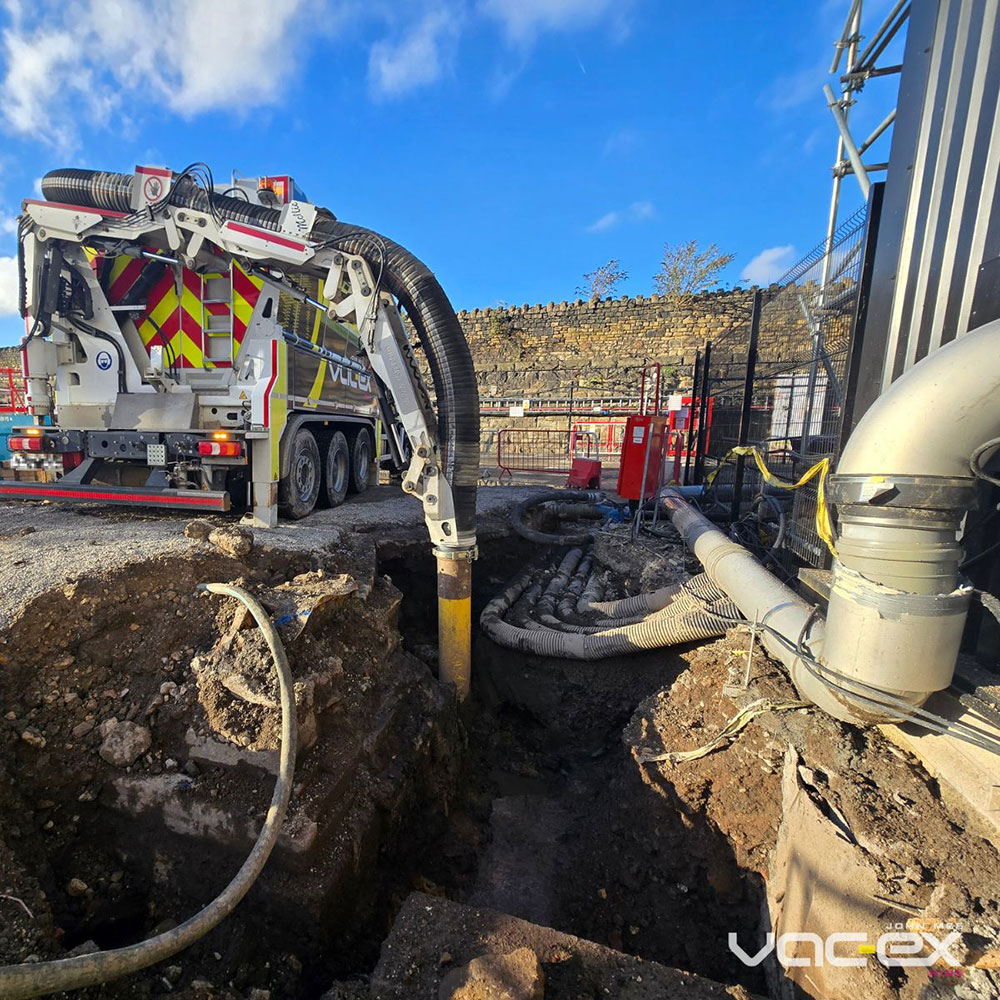
Vacuum excavation exposing underground utilities safely without mechanical digging.
Key Benefits for Utility Providers
Vacuum excavation provides:
- Zero-contact soil removal
- Superior visibility of buried assets
- Minimal manual digging
- Lower reinstatement costs
- Less man power
- Cleaner work sites
- Reduced disruption to surrounding areas
At John Mee Vac-Ex Hire, we specialise in providing operated vacuum excavation hire for projects requiring safe, precise ground exposure.
Compliance Is Driving Adoption
Utility companies must meet strict standards and best practice guidelines. Non-destructive excavation aligns perfectly with these requirements.
PAS 128 – Improving Utility Detection Accuracy
The UK standard for locating and verifying utilities is PAS 128. This standard offers a best practise framework for mapping buried services like water, gas, and electrical lines. Using vacuum excavation to expose buried assets is the safest method where PAS 128 workflows are correctly followed.
HSG47 – Preventing Strikes Around Underground Services
HSG47 focuses on avoiding electric shocks, gas leaks, and accidental service strikes. By using suction rather than mechanical force, vacuum excavation supports HSG47 guidance and vastly reduces damage risk.
This is one reason utility companies choose John Mee Vac-Ex Hire when working around high-risk or high-value infrastructure.
Insurance and Risk Reduction
As insurers become more aware of the impact of service strikes, many encourage or require non-destructive methods in high-risk environments. NDE strengthens contractor compliance, reduces claims, and demonstrates commitment to safe working practices.
The True Cost of Utility Strikes
Utility strikes are expensive on every level. The costs go far beyond simple repairs.
Direct Costs
- Compensation to asset owners
- Emergency callouts
- Stand-down time
- Delayed project timelines
- Equipment damage
These alone can cost tens or hundreds of thousands.
Indirect Costs
- Investigations and audits
- Lost productivity
- Client dissatisfaction
- Contract penalties
- Reputational damage
These hidden costs often exceed the direct repair bill.
Why Traditional Excavation No Longer Meets Expectations
Traditional digging carries far greater risk, especially in congested utility corridors. The risk-to-reward ratio no longer makes sense when safer, more precise alternatives like vacuum excavation exist. For this reason, many of our clients at John Mee Vac-Ex Hire now specifically request non-destructive excavation for all projects involving buried services.
Benefits of Non-Destructive Excavation for Utility Companies
Utility providers are making the switch for several compelling reasons.
Enhanced Safety on Site
Vacuum excavation eliminates the high-impact ground penetration that causes most strikes. This protects workers, local communities, and the asset network itself.
Faster, More Efficient Exposing of Services
Air and suction techniques expose services quickly and clearly. This reduces the need for manual digging and accelerates project delivery.
Reduced Environmental and Surface Impact
Because vacuum excavation is highly controlled, it causes less ground disturbance, making it suitable for:
- Urban settings
- Residential areas
- Landscaped environments
- Rail corridors
- Historic or sensitive sites
Ideal for Confined or Hard-to-Reach Areas
Vacuum excavators can operate in tight spaces where mechanical excavators simply cannot. This is particularly valuable in built-up utility corridors where precision is essential.
At John Mee Vac-Ex Hire, our equipment is specifically chosen to support work in restricted access environments.
Real-World Adoption Across the UK Utility Sector
Across water, gas, power, district heat, and telecoms networks, non-destructive excavation is now widely used for:
- Service verification
- Trial holes
- Leak repairs
- Fibre installations
- Joint bays
- Emergency callouts
- Substation works
The shift is happening because the benefits are clear. The utility sector needs precise, compliant, and safe methods – and NDE delivers exactly that.
When Should Utility Companies Use Non-Destructive Excavation?
NDE is ideal for:
Locating services and trial holes
Before excavation takes place, it is crucial to have an accurate picture of where services are located.
Proximity to sensitive infrastructure
When working close to sensitive infrastructure like gas mains, high voltage cables and active fibre lines, less invasive methods can increase the likelihood of a positive outcome.
Limited or awkward access
Environments such as highways, heritage sites, water treatment facilities and rail environments tend to have challenging access.
Why Utility Companies Trust John Mee Vac-Ex Hire
At John Mee Vac-Ex Hire, we offer safe, compliant and efficient vacuum excavation services for your utility work requirements. Our operated vacuum excavation hire service can help you with your projects that demand.
- A safe dig near utilities.
- Compliance with PAS 128 and HSG47.
- Reduced strike risk.
- Clean, precise excavation.
- Operators who have proven skills and experience and permission to access the industry.
Our team will ensure the safe and efficient delivery of your project, whether it be trial holes, exposing high-risk buried services or working in restricted access areas.
Non-Destructive Excavation Is the Future of Utility Groundworks
The utility industry is abandoning conventional digging for a simple reason the risk factors are too high. A non-destructive excavation is safer, and more compliant and offers a way to expose buried services without mechanical digging dangers.
As a result of increased focus on safe working practises, compliance, and long-term cost saving by companies, vacuum excavation is fast becoming the natural choice for projects across the UK. Our vacuum excavation hire can significantly improve your ability to complete work faster and more effectively.
Call us on 01302 366900
Or contact our hire team:"*" indicates required fields